Featured

The Great Christian Metanarrative

The-Adoration-of-the-Lamb

The Essence of the Faith and Why it Matters

Christianity is grounded in history.  While some might think of the Bible as a disjointed collection of ancient writings, the events recorded in the Bible really happened, and there is an overarching, central theme and message.  It is in understanding this theme, this metanarrative, that we find God’s purpose for humanity, and by extension for each of us as we seek to make sense of the world and find meaning for our lives. 

The writers of the biblical texts never attempt to show any beginning for God; they simply posit that He exists.  “In the beginning, God.”  He preexists creation.  (“He” because the Bible uses male pronouns.  “He” although God of course does not have a human body, incarnate God – Jesus – was a man.)  As God, the eternally existing God, the One by whom and through whom and for whom all things exist, God’s great design in all His works is the manifestation of His own glory.  Properly so; God is God.  

The Introduction – Creation

The Bible teaches us that we were created “in God’s image,” in some limited sense corresponding to Him and resembling Him, able to reason, able to choose, able to and meant to live in relationship with Him as well as with each other.  God created mankind out of His love and goodness in a condition of communication with Him and knowing Him.  It is here that we find the introduction to the grand story of human existence.

It is easy for those of us who accept creation as fact to get caught up in debates about details (and the details are not unimportant) and miss the point that ultimately cannot and must not be missed.  Eternal God, for His own purposes and in great display of ability, power, knowledge, and wisdom, created by fiat what we know as creation.  He created the physical universe substantially as it is, the celestial bodies, the earth, all designed and created as part of His plan.  He created the earth substantially as it is (great geological changes have occurred).  He created life on the earth, plants as plants, animals as animals.  All of this creation was designed as a home for humanity.  And he created humans – as humans.  Innocent of evil, in the image of God, mentally, morally, socially able to interact with Him, created for His divine purpose.  The Bible says in Colossians 1:16-17, “For by Him all things were created that are in heaven and that are on earth, visible and invisible, whether thrones or dominions or principalities or powers.  All things were created through Him and for Him.   And He is before all things, and in Him all things consist.”  This truth is both assumed and restated throughout scripture.

The Conflict – The Fall

Everywhere around us we see the manifestation of God in creation.  The world as we know it, humanity as we know it, all that we can perceive, is simply unimaginable without a Creator far beyond anything we can contemplate, far beyond anything of the natural world, far beyond chance development from eternal space-plus-time-plus-energy/matter.  Simultaneously, all around us we see disaster and destruction.  We sense the obvious, that something is not at all right.  The Genesis story of the creation of man is quickly followed by the story of man’s rebellion against God.  Made in God’s image, Adam had the capacity to make free choices.  Fully in relationship with their Creator, Adam and Eve made the disastrous choice to rebel against their Creator.  Life in obedience and harmony with God was an existence of enjoyment, life, knowledge, and achievement, but sin – disobedience to the Creator – brought disaster, loss of life, eternal death. 

The aftermath and consequences of that rebellion against God is the story of human history.  The earth itself became tainted, a punishment to mankind for sin, becoming less hospitable to humankind, with famines, plagues, pestilence, earthquakes, floods, droughts and disasters and hardships throughout time.  Disease, various maladies, and physical death became the fate of all.  Genesis chapter 6 records the great Flood, a dramatic act of divine destruction against an ancient world deeply in sin.  Untold millions have died in wars.  Persecution against perceived enemies, greed, selfishness, pride, murder, human sacrifice, and slavery, have characterized human history. 

Humanity exists amid this Fall, the great rebellion against the Creator.  The divine nature demands justice and judgement against that rebellion; God’s nature as God demands that He doesn’t merely tolerate rebellion.  Humans are not somehow merely flawed yet perfectible.  We are rebels against God.     

None of this came as a surprise to God.  The scriptures help us to understand that God is not the cause of sin, but for His own divine purposes allowed sin.  He is all-knowing and all-powerful, who exists outside of creation, outside of time.  As difficult as it might be at first to accept, God knew when He created man “in His own image” that man would sin and rebel against Him.  That rebellion, and more importantly the solution to that rebellion, is the heart of the great metanarrative. 

The Resolution – Redemption

God in His grace provided the way that we can be forgiven and restored.  The apostle Paul wrote of Christ in Colossians 1:19-21, “For it pleased the Father that in Him all the fullness should dwell, and by Him to reconcile all things to Himself, by Him, whether things on earth or things in heaven, having made peace through the blood of His cross.   And you, who once were alienated and enemies in your mind by wicked works, yet now He has reconciled . . .”  This was the plan of God, for His own glory, before creation, before time began.  Ephesians 1:4 reminds that God “chose us in [Christ] before the foundation of the world.”  It is here we find the culmination of history, the grand purpose of God, the reason for human existence. 

Jesus is God incarnate, born into humanity for the express purpose of dying for us, to demonstrate the consequences of sin and to pay the penalty for our sins.  After His death on the cross, Jesus rose again from the dead in triumph over death that came with human sin.  All who trust Him for salvation will be forgiven and made new, as Jesus’ death was the payment and full atonement on behalf of the people of all nations and of all history who turn from their sins and embrace Christ as Savior.  This is, essentially, the gospel, the essence of Christian teaching.  The gospel is based on the life, death, and resurrection of Jesus Christ, as Paul explains in 1 Corinthians 15 and elsewhere in his writings.  For since by sinful man death and destruction came, by the incarnate God Man came resurrection and restoration.  In Adam all died, even so in Christ we are made alive.  God created man, physical death and destruction came because of disobedience, and the Cross brought atonement, reconciliation, and the promise of a new heaven and earth.  The solution to human estrangement from God is not to be found in sacramentalism, ceremony, religion, or reformation.  Jesus Christ did the only needed and acceptable work.  What is required of us is acknowledgement of our guilt, humble admission of our rebellion both individually and as a human, and acknowledgement of Christ as Savior and Lord.  We must admit that we are rebels who must lay down our arms.

It is “The Cross” and what happened there that is the centerpiece of the metanarrative. The Old Testament points to and predicts it, the New Testament presents and explains it.  By it the sins of Christ’s people are atoned for; they are reconciled to God.  Everything else is subordinate to this plan, put in place by God’s providence for the sake of this plan.  In Jesus Christ on the cross divine holiness was demonstrated and justice was carried out.  God put the punishment of all our sins on Him, so that He might freely and graciously pardon believers, to the honor and exaltation of His justice, grace, and mercy, as Paul explained in Romans 3.

We should and must also consider the earthly ministry and teaching of Jesus and live our present lives in light of his teaching, but we should always remember that the purpose for which Jesus came was to die on the cross.  In the Bible’s book of Acts, chapter two, recording a sermon of the apostle Peter, one reads,  “Men of Israel, hear these words: Jesus of Nazareth, a Man attested by God to you by miracles, wonders, and signs which God did through Him in your midst, as you yourselves also know— Him, being delivered by the determined purpose and foreknowledge of God, you have taken by lawless hands, have crucified, and put to death; whom God raised up, . . .”  The reason for the incarnation and death of Jesus plainly centered around His death for us.  He was not merely a great leader or teacher or martyr who died for a cause.  It is here – the incarnation and the cross – that we begin to understand the grand plan for humanity.  Creation showed his abilities and much of what characterizes God as God, but it only went so far.  God’s ultimate purpose was not merely creation; it was Jesus Christ on the cross and on His eternal throne worshipped as savior by His redeemed for all eternity. 

The Bible indicates that outside of the creation we inhabit, there are “the hosts of heaven,” other created beings such as angels.  We might expect that an eternally existent infinite God would create throughout timeless eternity.  And in Christ and what He came to do God uniquely manifested Himself not only to humankind but to these numberless created beings.  When man sinned, God did something startling, grand, unexpected.  He demonstrated divine grace and love.  Infinite holy God provided a way for humans to be saved by the sacrificial substitutionary death of Christ.  It is here that we find the grand purpose for human existence.  God vividly displayed His infinite grace, love, mercy, and forgiveness.

In the Bible’s book of The Revelation, we observe that the “hosts of heaven” worship this “Lamb that was slain.”  The centerpiece of worship in heaven for eternity will be the display of the glory of the grace of God in the “Lamb that was slain.”   The suffering of Jesus Christ will be at the center of our worship and our wonder forever.  This is not an afterthought of God.  This was the plan before creation, the goal and purpose of creation and human existence, the reason why we exist.  The sacrifice of Christ is the focal point of the ages and of eternity for us.  It forever removed the sins of those who believe.  Angels and the redeemed of earth will sing of the suffering of this sacrificed Lamb forever; the suffering of the Son of God will never be forgotten.  We exist for God.  Jesus satisfied the Father’s justice, made the necessary atonement for sins, and created a people for God.   

The Epilogue – The Consummation

Over the last two thousand years, in the wake of the life of Jesus and the spread of Christianity, the gospel has been taught, people throughout the ages have believed that gospel and entered the spiritual kingdom of Christ’s followers.  Millions have believed the gospel, and in His divine plan God continues to add to the ranks of His eternal worshippers.  They have physically died but live on as worshippers of God, as subjects of His eternal kingdom.  They have left this life and entered a new existence with their Savior.  There is a consummation for each of us individually – we will all pass from this world and enter the eternal state.    

But the world still “groans” as the Bible says, still largely existing in the consequences of the Fall.  Of Christ’s first coming, Paul wrote in Galatians 4 that “But when the fullness of the time had come, God sent forth His Son, born of a woman, born under the law, to redeem those who were under the law, that we might receive the adoption as sons.”  Christ came “in the fullness of time,” at the time planned from the beginning.  After His resurrection, as He prepared to ascend into heaven, Jesus told His assembled disciples (Acts 1:6-11),

 Therefore, when they had come together, they asked Him, saying, “Lord, will You at this time restore the kingdom to Israel?”  And He said to them, “It is not for you to know times or seasons which the Father has put in His own authority.  But you shall receive power when the Holy Spirit has come upon you; and you shall be witnesses to Me in Jerusalem, and in all Judea and Samaria, and to the end of the earth.  Now when He had spoken these things, while they watched, He was taken up, and a cloud received Him out of their sight.   And while they looked steadfastly toward heaven as He went up, behold, two men stood by them in white apparel, who also said, “Men of Galilee, why do you stand gazing up into heaven?  This same Jesus, who was taken up from you into heaven, will so come in like manner as you saw Him go into heaven.” 

The epilogue of the metanarrative tells us that in God’s divine plan the present age will end at a divinely chosen time.  In His time, Christ will return suddenly and dramatically, as Earth’s rightful King to reclaim His country.  Judgement on the sins of the unrepentant will come.  God will intervene and bring righteousness, equity, and justice to the world, and believers will live eternally in unending praise of the One who died for their sins, in a world free from sin and its effects on a restored earth that will be ours to inhabit for eternity. 

Revelation 5:12-14 tells, “Worthy is the Lamb who was slain to receive power and riches and wisdom, And strength and honor and glory and blessing!” And every creature which is in heaven and on the earth and under the earth and such as are in the sea, and all that are in them, I heard saying: “Blessing and honor and glory and power Be to Him who sits on the throne, And to the Lamb, forever and ever!”  Believers of the ages will eternally worship, thank, and praise the Lamb who was sacrificed for our salvation.  This is the eternal plan and purpose of God.

This is essentially Christianity 101.  But, one might ask, so what? 

The Implications

For the Individual.  Creation in its grandeur displays something far beyond natural processes.  Observing creation, one does not necessarily come to conclude that the God of the Bible exists, but one must at least be open to the existence of a creator beyond creation.  The Bible causes us to understand that it is more God who seeks man rather than man seeking God, but observation of God demonstrated in creation and the created world coupled with the human conscience to some degree makes it incumbent that men do seek Him.  “God . . . now commands all men everywhere to repent.”

Those who have come to Christ and understand the great story of God’s plan for human redemption begin to understand that there is meaning and purpose to the world, to life, and to themselves.  Life is moving forward and heading toward an ultimate perfect eternal existence with God.  Our faith dictates the way we see the world, our attitudes and actions toward others, and our view of our self.  Individuals find their significance in knowing God.  Our existence has meaning; therefore, my existence has meaning.  As a believer, one comes to understand that we as human are sinful and fundamentally flawed, acknowledge our sin and rebellion, and humbly come to God.  We must live a repentant life, forming our attitudes and behavior in obedience to Him.  We understand that God our creator loves us so much that Christ died for us, and therefore we can and should live joyous, purposeful lives.  “Because He lives, I can face tomorrow.”  Despite difficulties, or enjoying positive circumstances, we live with an eternal perspective, understanding that our losses and our gains are both transitory.  God is sovereign and ultimately in control of His great grand purpose for creation and in His presence and purpose for us individually.  We are eternal worshippers of God; that is at the center of His reason for creating us, and we worship Him now in the totality of life.  As followers of Christ, it is He whom we worship in attitudes and actions, in giving excellence to the tasks in life, and serving those around us.  We worship Him when we learn and practice His ways outlined for us in the Bible.  While secularism and postmodernism cannot adequately answer the quest and longing for significance, meaning, and worth, Christianity with the unchanging central theme of Jesus Christ as Lord and Savior brings the answer to those questions.    

 There is an eternal Creator who has created and expressed His love toward us; thus, He is the source and definition of truth and knowledge.  Truth becomes absolute, not relative, in the Christian metanarrative, and this profoundly affects our perspectives and our behavior.  Our understanding about reality and how we see the world and therefore how we live, becomes completely different from those who have a different worldview not informed by an understanding of God’s program.  The great Christian metanarrative is the source of concepts long taken for granted in western culture, like human dignity and basic human rights.  The cultures and nations influenced by Christian teaching have historically developed in expression of those virtues.  Believers are uniquely able to be a positive force in society. 

Benevolence, charity, equity, fairness, justice, deference, humility, and respect for rights, are ultimately rooted in this understanding that God created and loves people.  Christ’s followers should love those who like us are created in God’s image.  Our virtues are to be an expression of our identity as a follower of Christ, and our desire to demonstrate the love of Christ is the primary motivation for expressing those virtues.  Christ died for sinners, so we declare the gospel, persuade, and convince sinners to end their rebellion and acknowledge Christ as Lord and become worshippers of Him.    

Paul wrote in Philippians 2 that ultimately every knee will bow at the name of Jesus Who humbled Himself to death on the cross.   All of creation—in heaven and on earth—ultimately will bow before Jesus Christ and Him alone (Philippians 2:10).  Believers will worship Him eternally and are called to worship Him supremely in this present life.  We live in anticipation.  We live with hope and optimism.    

For the Church.  Biblical churches are assemblies of followers of Christ, and churches have been found in cultures and societies throughout the centuries.  There is no liturgy given in the New Testament for the assembly of the local church, and those assemblies are very different in various circumstances and times.  Two ordinances have been given to the church, baptism and communion, and the central feature of both is the central truth of Christ.  In baptism, the death, burial, and resurrection of Jesus Christ is pictured, and the individual being baptized identifies with Christ and with the church.  In communion, the broken body and blood of Jesus is vividly remembered.  These ordinances are acts of worship, remembering and commemorating Christ as the atonement for one’s sin.  They put the work of Christ in the central place in the church.  That centrality is to be present in everything that the church is and does.    

It might be easier for a persecuted church to remain focused on Who God is and what Christ has done for us.  But too often the American church seems to have set the central metanarrative aside.  In previous decades especially, many in Fundamental and Evangelical circles embraced a decisional approach that often used some combination of ease and convenience, guilt, and emotion to elicit a “repeat after me” prayer that would then pronounce the convert as “saved.”  The danger here is that the person fails to understand the gospel, understand true repentance, and genuinely turn to Christ as Lord and Savior. 

The bigger failure today is the failure of churches to emphasize anything of the gospel at all.  Too often the concept of Jesus that is presented is as a great teacher, a martyr, an affirmer, a friend, a social reformer.  He is a source for inspiration, principles of success, and prosperity.  He condemns no sin, instead affirms every action and choice.  The Jesus that might be put forward is “radical” or “revolutionary,” with an emphasis on various social issues. The church assembles more to be entertained than to glorify God and commune with Him.

The metanarrative with the central truth of Christ as Savior and Lord are to be the core subject of what the church teaches, the superstructure on which all else is supported.  Scripture addresses a vast number of subjects, helps us understand how we should live, and so the church continuously addresses those topics.  We must learn to live successfully in the present world as a believer, to overcome the corruption present in society, to live out our faith in the totality of life.  We should enjoy interactions with other believers and help each other in life.  But if one attends a church and does not regularly hear of human sin, the need for repentance and faith, and the death, burial, and resurrection of Jesus Christ as the atonement for human sin, there is something wrong in that church.  If the themes and concerns of contemporary society crowd out the centrality of Christ, there is something wrong.  If the corrupt entertainment of the world is used in place of congregational singing of the gospel, there is something wrong.  If the blood of Christ is thought to be unattractive to a target audience and so is never mentioned, is never remembered in song, something is wrong.  The Lamb is the subject of the eternal “new” song and so should be now.         

Jesus at Calvary is the center point of human existence.  It is the theme of human sin and Christ as the solution to that sin that is to remain central – to the individual believer, and to a church.   

“Worthy is the Lamb who was slain to receive power and riches and wisdom, And strength and honor and glory and blessing!”
The Theology of Christmas

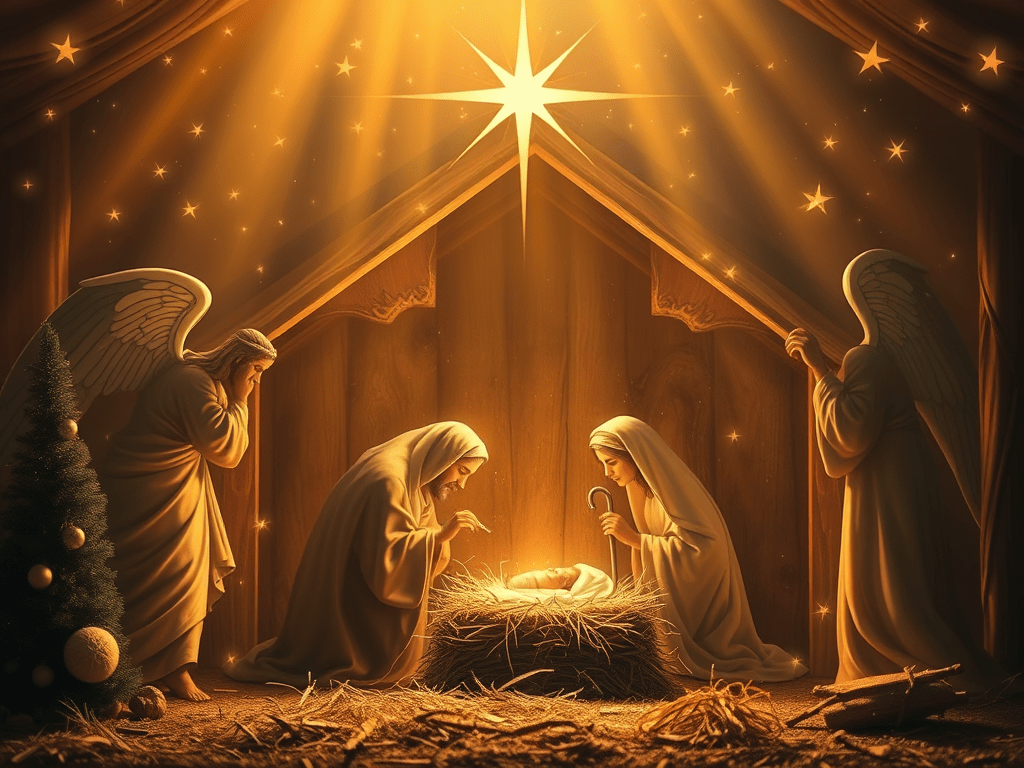
Christmas in our society has become primarily a time of the inescapable marketing of gifts. The culture has turned the religious aspect of Christmas into the story of the birth of a baby that is nothing more than that, and it is difficult to think of Christmas having any more profound significance beyond the remembrance of Jesus’ birth. Even for Christians there comes to be an emphasis on the nativity account with little thought of a deeper story. The details of the birth of Jesus recorded in Scripture are obviously vitally important, but they are but one aspect of this compelling story. One can well imagine many similar births (albeit not births to a virgin) occurring among poor Jews of the period of Jesus’ birth. But Christmas must be first and foremost a remembrance of the Incarnation, when Jesus Christ came into the world to save sinners. That is the element in the Christmas celebration that has lasting meaning.

Creation was a miracle, or rather perhaps a series of miraculous events, which is simply beyond human comprehension. It was an expression of the infinite power, ability, knowledge, creativity, and wisdom of the Eternal God, a tremendous display to the innumerable hosts of heaven. However, it was just that and only that, an extension of God in His nature as God, completely consistent with His obvious attributes. But there is a greater miracle: the Incarnation of the Son of God. It is that greater miracle that is the purpose to creation.

The New Testament book of Hebrews in chapter 2:6-8 references Psalm 8:4-6. In this psalm, David is in awe of God for creating and caring for creation, particularly people. The author of Hebrews points this passage to Jesus, who, by becoming a man, lowered Himself so that He could die for our sins. Hebrews 2:6-10 tells us

 But someone has testified somewhere, saying,

“What is man, that You think of him?
Or a son of man, that You are concerned about him?
You have made him for a little while lower than angels;
You have crowned him with glory and honor;
You have put everything in subjection under his feet.”

For in subjecting all things to him, He left nothing that is not subject to him. But now we do not yet see all things subjected to him.

But we do see Him who was made for a little while lower than the angels, namely, Jesus, because of His suffering death crowned with glory and honor, so that by the grace of God He might taste death for everyone.

For it was fitting for Him, for whom are all things, and through whom are all things, in bringing many sons to glory, to perfect the originator of their salvation through sufferings.

For in subjecting all things to him, He left nothing that is not subject to him. But now we do not yet see all things subjected to him.

But we do see Him who was made for a little while lower than the angels, namely, Jesus, because of His suffering death crowned with glory and honor, so that by the grace of God He might taste death for everyone.

For it was fitting for Him, for whom are all things, and through whom are all things, in bringing many sons to glory, to perfect the originator of their salvation through sufferings.

The Creator entered humanity and became as those created so that Jesus could be their salvation through His sufferings and provide the way to redemption.

C.S. Lewis argued in Miracles that the Incarnation is at the center of God’s redemptive plan for the world:

“The central miracle asserted by Christians is the Incarnation. They say that God became a Man. Every other miracle prepares for this, or exhibits this, or results from this.”

The Apostle John wrote in John 1:14-16,

 And the Word became flesh, and dwelt among us; and we saw His glory, glory as of the only Son from the Father, full of grace and truth. John testified about Him and called out, saying, “This was He of whom I said, ‘He who is coming after me has proved to be my superior, because He existed before me.’” For of His fullness we have all received, and grace upon grace.

From the day of His conception, Christ set aside His previous glory as God to come to the world to atone for our sin. This does not suggest in any way that He stopped being God, became man, and then changed back to being God again. When we read that “the Word became flesh and dwelt among us,” we must remember the paradox that He transferred Himself into His humanity without giving up His deity. He is fully God and fully man, and the Scriptures hold Christ’s two natures in perfect tension. He was not merely who he might have appeared to be. He was human, and He was God. The Apostle Paul explained this in Philippians 2:5-11:

Have this attitude in yourselves which was also in Christ Jesus, who, as He already existed in the form of God, did not consider equality with God something to be grasped, but emptied Himself by taking the form of a bond-servant and being born in the likeness of men. And being found in appearance as a man, He humbled Himself by becoming obedient to the point of death: death on a cross. For this reason also God highly exalted Him, and bestowed on Him the name which is above every name, so that at the name of Jesus every knee will bow, of those who are in heaven and on earth and under the earth, and that every tongue will confess that Jesus Christ is Lord, to the glory of God the Father.

Eternally, totally God, Jesus was born into the world of men and died on our behalf to atone for our unpardonable offense of rebellion against God. There was never a time when He was not God, yet although Jesus is fully God, He “did not count equality with God a thing to be grasped.” He further humbled Himself by “becoming obedient to the point of death, even death on a cross.”  The cross was the necessary solution to God’s indignation at human sin and was the supreme demonstration of God’s love for sinners through the gift of His Son. God alone determines how rebellious sinful people can be declared righteous in His holy presence, and He determined that it would be because of Christ’s death on the cross.

This death was the intention of God from before creation. Ephesians 1:4-10 declares that

just as He chose us in Him before the foundation of the world, that we would be holy and blameless before Him. In love  He predestined us to adoption as sons and daughters through Jesus Christ to Himself, according to the good pleasure of His will, to the praise of the glory of His grace, with which He favored us in the Beloved.  In Him we have redemption through His blood, the forgiveness of our wrongdoings, according to the riches of His grace  which He lavished on us. In all wisdom and insight  He made known to us the mystery of His will, according to His good pleasure which He set forth in Him, regarding His plan of the fullness of the times, to bring all things together in Christ, things in the heavens and things on the earth.

Further, in Ephesians 3:8-12,   

To me, the very least of all saints, this grace was given, to preach to the Gentiles the unfathomable riches of Christ, and to enlighten all people as to what the plan of the mystery is which for ages has been hidden in God, who created all things;  so that the multifaceted wisdom of God might now be made known through the church to the rulers and the authorities in the heavenly places This was in accordance with the eternal purpose which He carried out in Christ Jesus our Lord,  in whom we have boldness and confident access through faith in Him. 

Before creation, this was the fundamental purpose of God in creating humanity. The incarnation of God in Christ and the death of Christ bringing this eternal worship of the Lamb was the plan of God.

Christianity is completely focused on this atonement which distinguishes Christianity from all other religions. Christ became incarnate to offer up His life as a sacrifice. In 1 John 3:5 he is “manifested to take away our sins.”  He is our ransom in 1 Peter 1:18 and 1 Timothy 2:6, offers the appeasement of God’s wrath in Romans 3:25 and 1 John 2:2, and reconciles us to God in Romans 5:10 and 2 Corinthians 5:18-19. He is our substitute throughout the Bible, for example in Isaiah 53 and 1Peter 2:24, “and He Himself brought our sins in His body up on the cross, so that we might die to sin and live for righteousness; by His wounds you were healed.” 

One life given instead of another. God Incarnate died for our sins. This presupposes the miracle of the incarnation which was entirely in anticipation of the work of the atonement.

If we as followers of Christ are to observe Christmas, the emphasis should be this supernatural work of God in the incarnation. This is the greatest wonder, the most unfathomable miracle, that God ever did in the world. We ultimately cannot fully understand the Triune God, and we cannot fathom how God could become man in Christ. It is a great mystery, even as we acknowledge that God is all-powerful and can do all things.  While we may not comprehend the “how,” we can understand the “why.”  God Incarnate came to demonstrate grace, mercy, and love in the most magnificent manner possible, for His eternal glory. In our wondering, we simply acknowledge that there is no real peace, comfort, or future confidence to be found in anything or anyone else, only in the God Who exists, Who is sovereignly in charge, and Who demonstrated His love toward us in the most powerful way possible. Thus, the message of Christmas and Christ’s coming is the message of hope, forgiveness of sin, salvation, and eternal life for believers.

Songs of the Nativity like “Oh, Little Town of Bethlehem” and “Away in a Manger” are fine carols to sing at Christmas. But it is certainly more transformative and meaningful for Christians to sing of the incarnation. A hymn from the 1930’s occasionally heard at Christmas, “Thou Who Wast Rich Beyond All Splendor,” is such a hymn. The second verse reads

Thou who art God beyond all praising,
All for love’s sake becamest man;
Stooping so low, but sinners raising,
Heavenward by Thine eternal plan.
Thou who art God beyond all praising,
All for love’s sake becamest man.

Thoughts on the Passing of John MacArthur

John MacArthur was arguably the preeminent voice among Bible-believing evangelicals over the last century. His recent death caused me to reflect on his tremendous influence on my life.

I was a student at a small fundamental Baptist Bible college in the Los Angeles area many years ago. While generally sound in doctrine, the school was lacking in academics. I came to faith and was baptized as a boy in a small church, located in a barely lower middle-class Denver-area town, a church which was sound doctrinally but never was in any sense dynamic. We left that church when I was maybe sixteen and attended first one and then another church that similarly were sound in belief but were otherwise deficient. I was familiar with mediocrity.

One Sunday early in my third year at the college, I and a couple of friends drove across town to John MacArthur’s Grace Community Church. I had read one book by MacArthur but was not very familiar with his ministry. Attending Grace Church that Sunday was perhaps the most transformative event of my Christian experience. This was church. This was the message, the methodology, the New Testament pattern expressed in a modern American setting. Exciting, dynamic, in no way mediocre. We went back once or twice before the end of the school year. Over the years, I have listened to hundreds of recorded sermons by John MacArthur and have read many of his books. Though I live in Colorado, I returned to Grace Church a few times over the years.

John MacArthur was not a great orator. He was not entertaining. He was, rather, captivating for the hearer with any sort of spiritual hunger. He did not appeal to emotion. He used few illustrations or told few personal stories. A couple of years ago, alone on a road trip, I took three CD’s each containing one of his sermons to listen to. I recall hearing one illustration from his own experience, and it tied perfectly to the point he was making. He simply expanded the Bible, explaining scripture with scripture. He was a consistent defender of truth and an outspoken critic of anything that deviated from the truth.

One finds Grace Church very much as it was on my first visit there, unaffected by the various trends that plague American evangelicalism. The music in a service is doctrinal, joyful, and reverent, and the lesson or sermon is rooted directly in scripture. There are and never have been any gimmicks, fads, or entertainment.

One of the early sermon series to which I listened was MacArthur’s series preaching through Ephesians, a series of more than sixty messages. The phrases “equip the saints to do the work of the ministry” and “speak the truth in love” stand out in my memory from those messages. His formula was simple. Absolute fidelity to scripture. Preach and teach the scripture. Expound, interpret, and apply. Equip the saints to do the work of the ministry. Just what the Apostle Paul exhorted.

There is much we should learn from the ministry of John MacArthur, a faithful man who studied to “show himself approved” and who “preach(ed) the Word.”  Pastors would be wise to follow his pattern. Christians who read and listen to his material will surely find themselves “equipped.”  What he accomplished he did not do alone. His voluminous writing required much assistance. Grace Church is what it is because of countless ordinary individuals who faithfully did “the work of the ministry.”  Christians would do well to attach to a faithful ministry and faithfully support it.

Of MAGA, MALA, and MABA – A Conservative Christian Case for Donald Trump

I am a theologically conservative evangelical, a fundamentalist, and a biblicist holding to the inspiration and authority of the Bible.  I wish that there were a presidential candidate in 2024 who shares my faith, who understands salvation by grace through faith, who understands what Jesus has done for us in offering Himself as the atonement for our sin and offers us salvation if we but repent and believe the Gospel.  I lack confidence that Donald Trump has that commitment.  As a political conservative, I wish Mr. Trump held to a conservative political philosophy more in the likeness of Calvin Coolidge or William F. Buckley or Ronald Reagan.  I wish that Mr. Trump’s personal ethical history were more like that of Mike Pence and less like Bill Clinton.  I wish that he did not choose to battle with people in his political party who may disagree with him but whose support he needs.  I wish he were ten years younger, and that he were much more careful not to give soundbites to his critics through unguarded remarks.  It would have been better that on January 6 he had told his supporters to leave Washington a better place than they found it and to express their thanks and respect to law enforcement, in contrast to the BLM rioters months earlier.  Nevertheless, despite these and other areas of disagreement, I am convinced that given the available alternative it is imperative for the nation that Mr. Trump be elected in November.

Americanists vs. Transformationists. John Fonte of the Hudson Institute, in a speech reprinted in “Imprimus,” concluded that “Today’s polarization should be viewed as an existential struggle between Americanists and Transformationists.”  That is an apt description.  He said, “The conflict today is not simply a normal policy argument between conservatives and progressives. It is over the future of the historic American nation, both its creed and its culture.”  Americanists believe in traditional values, believe in the American Republic, its exceptionalism and its founding documents – to some extent, MAGA ideas.  Transformationists like Mr. Trump’s opponents are essentially socialists, collectivists, internationalists, even Marxists, who seek to effectively destroy the Republic.

The presidency is about more than just the president.  The American president is surrounded by a large number of people and appoints a vast number to various positions.  Mr. Trump would be surrounded by and appoint people who are Americanists.  His opponent Ms. Harris would be influenced, even controlled by, transformationists, as is the current president.      

To the transformationists, everything of traditional America is “racist” or some other “ist” or “ism” to be demolished.  The free-market economic system that has brought great prosperity is something to be disdained and destroyed.  There is no ethical barrier to bringing about their desired change; indeed, traditional Judeo-Christian ethics are perceived negatively.  To the far Left, the end always justifies the means. 

The Rite of Abortion.  Celebration vs. Regulation.  It is almost unimaginable that an American political party would present abortion as their signature issue, as do the Democrats.  It is a rite of their secular religion, something to be almost celebrated.  “Safe, legal, and rare” is long gone.  Abortifacients are to be dispensed like aspirin, at taxpayer expense when necessary.  This, as well as late-term surgical infanticide is to be considered an absolute right, a healthcare procedure of no more consequence than a tooth extraction.  Speech against abortion is considered “hate speech” to be opposed, and even presenting alternatives to abortion cannot be tolerated.  The Democrats offer a sort of grand bargain: Let us micromanage every other aspect of your life, and we will guarantee your freedom to fornicate at will as you please, and we’ll make sure there are no inconvenient unintended children as a result.

Most conservative Christians wish that Mr. Trump were more outspoken in opposition to abortion.  But in the absence of a societal consensus on the issue, absolute opposition to abortion is a losing political issue.  A Trump administration, however, would allow and encourage free speech and open debate on the issue.  We will be free to offer alternatives to abortion, to point out the barbaric nature of it, to attempt to educate and persuade and attempt to make opposition to abortion a winning issue. The states will continue to be free to regulate the issue, with some states, like the one where I live, having laws and policies that promote abortion on demand for any reason, with some states effectively banning it.            

MAGA vs. MALA (Make America Latin America).  The current immigration situation is a disaster for the country.  This cannot be overstated.  It is not a “failed border policy,” as some conservative critics call it; the flood of illegal immigrants is intentional on the part of the Left, part of their goal of transforming the country, overwhelming society and overwhelming the welfare state to create conflict.  Multilingualism and multi-culturalism inevitably create division and conflict and weaken society.   A Trump administration will work to stop and hopefully reverse this situation.

MAGA vs. MABA (Make America Broke America).  Elon Musk recently wrote on X (Twitter), “The rise in prices (inflation) is caused by government overspending, which increases the amount of money faster than the increase in goods & services output. That is the vast majority of the problem. Inflation was particularly bad during the Covid years, as there was massive government spending, despite productivity plunging, as people were forced to stay home. This is further exacerbated by excess regulation, which prevents the market from solving an unmet need (e.g. housing in high-demand areas).”  He is correct.  The Left will continue to spend the country into economic ruin.  Free stuff isn’t free; it must somehow be paid for. The immigration disaster guarantees further government overspending on an ever-expanding welfare state.  Price controls and vilifying business as the supposed cause of inflation will bring more economic harm to the country.  A Trump administration will be much less inclined to gross overspending, and the first Trump administration was marked by cutting regulation, likely to be repeated in the second.

“Democracy.”  The Left somehow imagines that Mr. Trump is some sort of threat to traditional democracy. (He IS a threat to democracy as it is defined by the far Left.)  The current bloated administrative state and ever-expanding governmental regulation is anything but democratic.  This is the true threat to democracy that we face, and a Trump administration would be inclined to reverse this situation. “Drain the Swamp.”  Further, there is nothing democratic about weaponizing the justice system against a political opponent, as has been done to Mr. Trump.

Free Speech.  It is hardly democratic to oppose free speech and freedom of expression.  Government has begun to “collude,” a word the Democrats like, with media to control free speech and to amplify falsehoods.  The false Russia collusion narrative, the suppression of the Hunter Biden laptop story, and suppression of COVID information contrary to the official narrative are but three examples.  According to the Left, one must not distribute “misinformation” as defined by Big Government. Speech must be regulated and censored. Expressing Christian truth on issues is being silenced in Europe, and such censorship is a real threat in America.  The Left does this to further their objectives.  A Trump administration will not do this and is likely to facilitate free expression of ideas.

MAGA vs. MABA (Make America Burn Again).  The Democrat vice presidential nominee, governor of Minnesota during the 2020 Minneapolis riots, did nothing to stop those riots, and reportedly he, his wife, and his daughter almost celebrated them.  Kamela Harris also celebrated the 2020 riots even to the extent of raising bail money for the few rioters who were arrested.  She expressed sympathy for the defund the police movement while it was politically expedient to do so.  Crime destabilizes a a country, and the Left uses it to their advantage. Arresting criminals is wrong or “racist.”

_______________

In a sermon preached five years ago, pastor and theologian John MacArthur noted that “God has warned our entire culture.  The election coming up next year is basically a referendum of divine wrath.  All the things that mark wrath—insanity, immorality, and homosexuality—are the very things that the Democratic Party makes a platform out of protecting.”  More recently (reported in an article in “The Christian Post), this pastor expressed that

“when a society “turns to sexual immorality, homosexual immorality, and a reprobate mind, God gives them up,” noting that the current administration is a manifestation of the societal punishment described in Romans 1.  “When He gives them up, it means he gives them up to the consequences of their choices . . .  If you follow that pattern, what you get is Joe Biden, who is the epitome of all those things that I just talked about.”  . . . The pastor did not mince words when discussing the personal and familial aspects of Biden’s life, claiming immorality ran “rampant” at an “epic level.”  He dismissed the notion that political figures like former President Donald Trump could be the solution to the nation’s moral and spiritual decline, although he considered a second Trump presidency a “huge move in the right direction.””

He is correct.

America faces great peril.  The Bible’s book of Leviticus tells us that

‘You shall not make idols for yourselves . . .  ‘If you walk in My statutes and keep My commandments, and perform them, then I will give you rain in its season, the land shall yield its produce, and the trees of the field shall yield their fruit. . ..‘But if you do not obey Me, and do not observe all these commandments, and if you despise My statutes, or if your soul abhors My judgments, so that you do not perform all My commandments, but break My covenant, I also will do this to you: I will even appoint terror over you. . ..I will set My face against you, and you shall be defeated by your enemies. . .. I will bring the land to desolation, and your enemies who dwell in it shall be astonished at it.”

This passage was given to the ancient Jewish nation, not to America, nor to the church (and we must never conflate the Jewish nation with America or with the church).  But it reminds us of a principle found in Proverbs 14:34 – “Righteousness exalts a nation, But sin is a reproach to any people.”  The United States, truly an exceptional nation, has been uniquely blessed by God.  It will be preserved as a free and prosperous nation not by any political party nor by any politician.  It will be delivered from destruction by people who commit to live by the principles of scripture, by people who turn to the God of our Founders.    

MAGA.  MARANATHA!

Middle Americans and Donald Trump

Nearly three years after his presidency ended, and after years of relentless pounding by the media and the political Left, Donald Trump still enjoys broad support among traditional middle Americans.  Drive across the prairies and plains from Minnesota and Montana to Texas, across the Midwest and the South, and one still commonly finds Trump 2020 signs.  Middle American Trump supporters are deeply patriotic, and one often finds a Trump sign mixed in among American flags across the countryside, towns, and cities.  This show of support will increase now that Mr. Trump has announced his candidacy for 2024.  Visiting souvenir shops or T-shirt shops in places like South Dakota or Tennessee as I have in the last year one will find numerous items supporting Mr. Trump and disparaging the current president and vice-president.  A great segment of the citizens of our country continues to long for the Trump presidency.

Who are these people?  Except for the populace in the dozen or so of the largest metropolitan areas, they may be a majority of Americans.  They are the descendants of the silent majority of fifty years ago and the Moral Majority of forty years ago.  Many of their grandparents and parents listened to Paul Harvey commentary on the radio each day, their parents and they themselves listened faithfully to Rush Limbaugh.  Middle Americans are those who Barak Obama belittled for clinging to guns and religion, Hillary Clinton disparaged as “deplorables,” Joe Biden darkly criticized as “MAGA extremists.”  Like their grandfathers, fathers, uncles, and brothers they often proudly served in the military.  They hold a deep respect for America, its founding fathers, and the governing documents the founders left us.  Many, like me, are people of deep faith, often evangelical Christians of one sort or another.   And they are deeply concerned for the future of the United States.  They see the unprecedented societal collapse that is now occurring with a mixture of anger and fear.

Traditional Americans know that their country is in grave peril.  And they know that Donald Trump understands this.  He “gets” them.

Middle Americans are at best skeptical of human-caused climate change and see a deeper agenda at work behind the “green” energy movement.  They understand that the United States has tremendous energy resources and wish the country to continue to use those resources.  Free-market capitalists in their disposition, they want to pay their own bills and build their own businesses, provide for their own families and save for their own dreams and do not want the continued economic drain of myriad taxes, fees, and regulations.  Middle Americans know that running up trillions of dollars in debt can do nothing but destroy the prosperity we enjoy.  “Entitlement” is a dirty word to them, just as “welfare” was to their parents.  They are compassionate, but don’t want a welfare state.  That compassion extends to valid refugee and asylum claims but they view with alarm the continued overrunning of the country by illegal immigration.  They are beyond tired of charges of “racism” or some other newly invented “ism” at every turn, tired of victim mentalities and the failure to prosecute criminals, tired of the normalization of sexual perversion.  Though most middle Americans do not likely understand much of the philosophic Marxism being pushed on the country by the Left, they are opposed to the various manifestations of it that they observe in government, academia, and the media.

Saul Alinsky was an influential twentieth century American Marxist, often cited as an inspiration to left-leaning politicians like Barak Obama.  One of his celebrated principles in his work “Rules for Radicals” was to “Pick the target, freeze it, personalize it, and polarize it. Cut off the support network and isolate the target from sympathy. Go after people and not institutions; people hurt faster than institutions.”  Few middle Americans have ever heard of Alinsky but understand that the disdain of the left for Mr. Trump is really a disdain for traditional America.  Mr. Trump is the “target” that has been personalized.  Those who are the most disparaging of Mr. Trump are those who hate America as it has been known.

What of Donald Trump himself?  The failings and shortcomings in his personal life have been well documented in the press, even amplified.  “You’re hired. You’re fired. You’re a (bleep)“ is no way to run a business, let alone the highest levels of our government.  Many of his presidential appointments were excellent; some were almost puzzling and poor.  His constant degradation, put downs, and feuding with those who should be his allies is concerning and ultimately counterproductive; this may be his biggest failing as a political leader.  He often is simply too focused on himself rather than the interests of the country.  His age is an issue – should he be elected again, he would be seventy-seven when he would assume office; the current president is a barely-walking demonstration that such advanced age is not ideal for a president.

There are likely better potential presidential nominees for middle Americans to support.  Others can carry the populist and libertarian themes Mr. Trump often articulates and are certainly better able to articulate conservative policies and themes.  The Republican party has a couple of governors, a few senators, and a few former Trump administration officials who would make a strong president.  But if Mr. Trump does indeed secure the nomination, against any conceivable nominee of the party of the Left, most traditional middle Americans like myself will vote for Mr. Trump in a heartbeat.  He gets us.

MAGA

______________________

Ultimately, human government will fail.  Those of us who are Christians are reminded in Scripture (Isaiah 9:6) that

For unto us a Child is born,
Unto us a Son is given;
And the government will be upon His shoulder.
And His name will be called
Wonderful, Counselor, Mighty God,
Everlasting Father, Prince of Peace.

More than a better America, we long for the eternal Kingdom of the Wonderful Counselor, Mighty God, Everlasting Father and Prince of Peace.

MARANATHA

Chickens and Babies

On recent trips to the grocery store we’ve noted that eggs and chicken have become expensive.  This is from a combination of general inflation, increased commodity and feed prices, and especially a bird flu epidemic.  Prices will come down when the bird flu abates, but will likely stay elevated, at least where we live.  Colorado, our home, has recently enacted new legislation that will give new rights to chickens and other domestic fowl and specifies for instance that they must have minimum amounts of space.  The governor’s homosexual partner is a rabid animal rights activist, and the legislature is firmly controlled by the Left, so this is not a surprise.  Regulations coming into effect later specify that egg producers must provide perches, nesting spaces, scratching areas, and dust baths, and farm operations face a civil penalty of up to $1,000 per violation of the regulations.  California has similar rules and has enacted laws specifying confinement space and area for hogs, driving up prices, and these are standards that Colorado may end up adopting, as Colorado often allows California to set the pace on legal issues.  Agricultural interests are at best divided on some of these rules, noting for instance that more loosely confined hogs are prone to harming each other, as well as other problems.  Regardless, reasonable people agree that needlessly harming a domestic animal is wrong, and even livestock might rightly be protected from tortuous conditions.

In Colorado, chickens have rights.  Mimicking California, the state also has some of the most ghoulish abortion law on Earth.  In both states, a pre-born child essentially does not exist for legal purposes.  One expects that a child could survive a late-term abortion and be killed outside the womb by the abortionist or be left to die without any consequence.  A woman carrying a full-term baby could be harmed, causing the death of the child, and while the assailant might be prosecuted for the crime against the woman, there is no consequence for causing the death of the child.  In our society, chickens have rights; pre-born human beings have none.

One routinely witnesses the promotion of abortion by politicians and in media.  We can wonder about the rationale behind this; perhaps guilt from past involvement in the practice is often the motivator.  In some states, abortion is paid for at taxpayer expense, while improperly confining a chicken is fined.  It is proclaimed as a good thing, a right not to be tampered with.  The vast majority of abortions are for convenience, and “Eat, drink, fornicate, and be merry, for tomorrow we die” is the post-modern, existential philosophy of the day.  Children, like marriage and family, are no longer considered desirable.  The traditional family is no longer the norm.  Child abuse is almost epidemic, and a child born into a less-than-ideal situation is more likely to be abused, neglected, or become a financial ward of the state.  In some inner-city subcultures, most births are to unmarried teen mothers who themselves were born to unmarried teen mothers.

The birth of a child is a life-changing event.  As a parent to two, and grandparent to one and one on the way, I am very aware of this.  It is time-consuming, sometimes emotionally draining, and financially challenging, even when a child is planned, wanted, and born into a stable one-man-one-woman-for-life marriage.  But surely it must be acknowledged that there is something wrong, profoundly wrong, in a society that gives legal rights to chickens but refuses to give any protections to an unborn child.

The ancient prophet Isaiah wrote (Isaiah 5:20), “Woe to those who call evil good, and good evil;
Who put darkness for light, and light for darkness; Who put bitter for sweet, and sweet for bitter!”  Isaiah wrote to a declining, dying society, just like ours.  A society where evil was accepted, and good was disdained.

I recently saw the ultrasound photos from my daughter’s pregnancy.  Just past the mid-point of the pregnancy, one can discern the tiny hands, feet, and head, and the ultrasound revealed the sex of the baby – it’s a girl!  Not yet quite able to live outside the womb, she is a genetically complete human being with a beating heart, to be born in a few months, a human being reflecting the image of God.  David the psalmist wrote in Psalm 139,

For You formed my inward parts;
You covered me in my mother’s womb.
I will praise You, for I am fearfully and wonderfully made;
Marvelous are Your works,
And that my soul knows very well.
My frame was not hidden from You,
When I was made in secret,
And skillfully wrought in the lowest parts of the earth.
 Your eyes saw my substance, being yet unformed.
And in Your book they all were written,
The days fashioned for me,
When as yet there were none of them.

Regardless of race, sex, economic status, or the circumstances of conception and birth, a baby is a human being, created in the image of God, here in one sense by chance, yet by God’s choosing.  To deny that is grievous error.  To use Christian terminology, to intentionally cause the death of the unborn child is sin.

We are all born sinners, members of a race in rebellion against the Creator, but thankfully, any of us – regardless of any sins we commit – can be “justified freely by His grace” if we will but repent and believe the gospel.  The apostle Paul wrote, in Romans chapter 3,

“But now the righteousness of God apart from the law is revealed, being witnessed by the Law and the Prophets, even the righteousness of God, through faith in Jesus Christ, to all and on all who believe. For there is no difference; for all have sinned and fall short of the glory of God, being justified freely by His grace through the redemption that is in Christ Jesus, whom God set forth as a propitiation by His blood, through faith, to demonstrate His righteousness, because in His forbearance God had passed over the sins that were previously committed, to demonstrate at the present time His righteousness, that He might be just and the justifier of the one who has faith in Jesus.”

The Easter Extravaganza

Traveling on a freeway while vacationing in another state recently, I noticed a billboard that advertised an “Easter Extravaganza” to occurr on the upcoming Easter weekend. Driving at highway speed, I did not have time to study the sign and did not catch the details at the bottom. Perhaps the sponsor of the event was a municipal or social organization, or maybe a religious organization or large church.  Most of the few thousands of people driving this stretch each day likely would not have even noticed the sign, but among those who did, I wondered, what might they expect of an “Easter Extravaganza?”

If a civic or municipal organization were the sponsor, likely the event would include an Easter egg hunt and candy for kids, maybe presents and costumed bunnies. Lots of spring-themed decorations, flowers, and Easter baskets along with the abundant Easter eggs and candy. If the organizer were a church, along with the eggs and candy, maybe a rock concert featuring songs with undefined references to “Jesus,” “Cross,” “Resurrection,” and themes of affirmation, inspiration, personal renewal and happiness, followed by a talk featuring such themes, somehow tied to the death and resurrection of Jesus Christ. After returning home, I noticed a church that I drive past often advertising an Easter egg hunt, and many area churches offer things like a “Community Easter Egg Hunt.”

Biblical Christianity knows nothing of such an Easter extravaganza. Is there any harm in giving Easter candy and coloring eggs and the like? Really, no. We enjoy such cultural traditions with our children. But American societal Easter traditions in truth fall outside of anything we find in the Bible. We can wonder about the idea of a church using cultural Easter traditions as a community outreach and debate the wisdom of using such methods to attempt to communicate the real gospel.

Nevertheless, the Bible does tell us of a real cause for celebration, a real extravaganza. A celebration not featuring eggs and a bunny, but A Lamb.

In 1 Corinthians 15, the Bible tells us,

Moreover, brethren, I declare to you the gospel which I preached to you, which also you received and in which you stand, by which also you are saved, if you hold fast that word which I preached to you—unless you believed in vain. 3 For I delivered to you first of all that which I also received: that Christ died for our sins according to the Scriptures, 4 and that He was buried, and that He rose again the third day according to the Scriptures, 5 and that He was seen by Cephas, then by the twelve . . . 14 And if Christ is not risen, then our preaching is empty and your faith is also empty . . . . 20 But now Christ is risen from the dead, and has become the firstfruits of those who have fallen asleep. 21 For since by man came death, by Man also came the resurrection of the dead. 22 For as in Adam all die, even so in Christ all shall be made alive.   26 The last enemy that will be destroyed is death . . .. So when this corruptible has put on incorruption, and this mortal has put on immortality, then shall be brought to pass the saying that is written: “Death is swallowed up in victory.”

In the book of The Revelation, the Apostle John wrote,

(Chapter 6) And I looked, and behold, in the midst of the throne and of the four living creatures, and in the midst of the elders, stood a Lamb as though it had been slain . . . Now when He had taken the scroll, the four living creatures and the twenty-four elders fell down before the Lamb, each having a harp, and golden bowls full of incense, which are the prayers of the saints. And they sang a new song, saying:

“You are worthy to take the scroll,
And to open its seals;
For You were slain,
And have redeemed us to God by Your blood
Out of every tribe and tongue and people and nation,
10 And have made us kings and priests to our God;
And we shall reign on the earth.”

11 Then I looked, and I heard the voice of many angels around the throne, the living creatures, and the elders; and the number of them was ten thousand times ten thousand, and thousands of thousands, 12 saying with a loud voice:

“Worthy is the Lamb who was slain
To receive power and riches and wisdom,
And strength and honor and glory and blessing!”

13 And every creature which is in heaven and on the earth and under the earth and such as are in the sea, and all that are in them, I heard saying:

“Blessing and honor and glory and power
Be to Him who sits on the throne,
And to the Lamb, forever and ever!”

14 Then the four living creatures said, “Amen!” And the twenty-four elders fell down and worshiped Him who lives forever and ever.

(Chapter 7) 15 Therefore they are before the throne of God, and serve Him day and night in His temple. And He who sits on the throne will dwell among them. 16 They shall neither hunger anymore nor thirst anymore; the sun shall not strike them, nor any heat; 17 for the Lamb who is in the midst of the throne will shepherd them and lead them to living fountains of waters. And God will wipe away every tear from their eyes.”

The scriptures do not tell us of a seasonal celebration of Easter, but rather a joyous, eternal celebration of the resurrected Lamb.

Music, Vacations, and Pandemics

Music is a powerful influence in both the life of an individual and of a society, and the music of a culture or subculture is a deep and profound reflection of that culture, its values, its underpinnings, and its perspectives on life.  The music one listens to demonstrates to some degree who that person is.  It is an expression of the soul.  Further, the kind of music one listens to ultimately shapes what that person is becoming; it has a definite effect on people.  We are constantly surrounded by music when we are in public places.  On a recent vacation, we went to play miniature golf at a course near our hotel, and a group of workers were performing maintenance on a small restaurant building near the course.  They were listening, perhaps on a local radio station, to music that was blaring, not quite deafening as we played the holes nearest to them.  I am not sure of the genre, perhaps rap and hip-hop, and it was loud, certainly featuring no pleasing melody or harmony, the lyrics generally indiscernible and when occasionally understandable the words were unsavory at best.  I silently wondered why one would listen to such, and what effect it might have on a person.

Often in stores, restaurants, and places of business, sometimes in public conveyances, certainly in current movies or entertainment, we are confronted by the music of the society and various subcultures.  If one is fortunate, perhaps it is merely “elevator music,” perhaps banal and benign country, or “soft” rock.  Less fortunately, one might be subjected to excessive volume, a driving beat and percussion, noise, and lyrics that are raunchy.  Hollywood, rock, hip-hop, rap, shock radio, and a host of other pop culture obsessions, helped by mainstream media and the general secular academy, have indoctrinated recent generations to encourage depravity and distract from that which is important, worthwhile, and virtuous.  Everywhere it seems we are surrounded by the music that is one of the manifestations of the self-destructive nature of morally deviant pop culture.

__________

When we returned home from the vacation, we went to church on the next Sunday.  As a believer, it was a joy to be assembled with other believers, singing words expressing Christian doctrine, singing the gospel, singing biblical themes with joy and reverence, with music featuring pleasing sounds of melody and harmony.  Singing that proclaimed the gospel, that expressed corporate worship to the Lord, that spoke “to one another in psalms and hymns and spiritual songs.”  Not the music of movie themes, not of a contemporary subculture, but of a profoundly different culture – the body of Christ.

During the early days of the Covid panic, we were of course unable to gather on Sunday with other Christians in church.  Our church was able to go online with the Sunday services from a nearly empty auditorium, but it was not close to the same.  A big part of what was lacking was the experience of reverent, orderly, joyful congregational singing.  The Bible says much about the subject of music, and there are perhaps five hundred references to music in the Bible.  The Creator knows that music has an effect on people’s lives.  He is worshipped when the assembled church sings of who He is and what He has done for us in Christ with mindful, joyful reverence.

In Revelation 5:9, the Bible depicts a scene in heaven for us and tells us, “And they sang a new song, saying: “You are worthy to take the scroll, And to open its seals; For You were slain, And have redeemed us to God by Your blood out of every tribe and tongue and people and nation . . .“  This is not a “new” song merely in chronology; it is “new” in kind and substance, recognizably different in nature from something else of a similar type.  Different than the old songs of the earth.  Just as in heaven, so it can and should be in this life.  The psalmist speaks of a “new song” in, for instance, Psalm 40:3, 96:1, and 98:1, a song that reflects the direction of our heart, a song that reminds us of Who God Is and, now in this age after the cross, what He has done for us in Christ.

“And do not be drunk with wine, in which is dissipation; but be filled with the Spirit, speaking to one another in psalms and hymns and spiritual songs, singing and making melody in your heart to the Lord, giving thanks always for all things to God the Father in the name of our Lord Jesus Christ, submitting to one another in the fear of God.  (Ephesians 5:18-21)”

“Let the word of Christ dwell in you richly in all wisdom, teaching and admonishing one another in psalms and hymns and spiritual songs, singing with grace in your hearts to the Lord.  And whatever you do in word or deed, do all in the name of the Lord Jesus, giving thanks to God the Father through Him.  (Colossians 3:16-17)”

Joining the Jesus Movement

Months ago I received an e-mail from a post-christian Protestant denomination.  Titled “Welcoming Others to Join Our Jesus Movement,” it included an appeal to support “Ministries that make a difference in our world and propel us forward to walk in the way of Jesus.”  Bullet points pointing to these ministries included: Creation Care – advocating for the care of God’s creation; Evangelism – welcoming others to join our Jesus Movement; and Racial Reconciliation – working to create a Beloved Community for all citizens.  Essentially, “jump on the Jesus train, become an environmentalist, and focus on social justice.”  On Easter Sunday, many in the broad spectrum of christianity who attended a church or listened online heard sermons on subjects similar to the above, as they do most weeks, while many heard themes like Spring, victory following defeat, happiness and prosperity and success, or affirmation coming from the inspiring story of Jesus.

The “gospel” so often referenced on Easter and in other sermons, the messages that are the focus of the entertainment-modeled music heard in the typical evangelical, are “gospels” featuring themes of self-affirmation, prosperity, happiness, success, triumph, self-reform, or calls to societal change inspired by “Jesus.”  The approach is usually happy, upbeat, and affirming rather than reverent, repentant, and truly joyful.  The focus becomes “who I am” or “who I can become” because of God.  That, however, is not the Gospel of the Jesus of the Bible.  It is a deception.  It is a “pied piper” gospel, strong and delusive, making irresponsible promises, attracting followers, but not focusing on grace, faith, regeneration, and repentance.  It robs God of the glory rightfully His.  And, by not declaring the Gospel of scripture, it does not address the true need of the human heart.

__________

The local church we are part of had both an Easter/Resurrection Sunday service and a service on Friday evening.  The Friday service was memorable and was the perfect pattern for a church service.  The account of the trial, crucifixion, and burial of Jesus from Matthew 26 and 27 was read in sections, with a traditional hymn or gospel song appropriate to the occasion sung by the congregation between each reading.  The ordinance of Communion was observed, with time devoted to individual reflection and prayer, and the congregation was lead in corporate prayer.  Attendance by visitors outside of the congregation had been encouraged, and the Gospel was clearly proclaimed, from the scriptures, in song, in the observance of Communion, and in brief remarks by the pastor.  On Sunday morning, the pastor spoke from the resurrection account in Matthew 28, completing the account of the death, burial, and resurrection from Matthew’s gospel.  True worship draws the attention of the worshipper to God, to His nature, to His majesty, to who He is and what He has done for us in Christ.  What our church did that weekend did just that.  

The message of “Good Friday” and “Easter” is not primarily “me” focused.  It is not merely “By Your spirit I will rise from the ashes of defeat, the resurrected king is resurrecting me.”  No, the message of “Easter” is ultimately God-focused, Christ-focused, Gospel focused.  It is the message of sin and the wrath of God against human sin demonstrated and satisfied by Christ on the cross.  It is the message of the literal resurrection of Jesus Christ in victory over sin and death.  It is the message of the salvation of those who in repentance and in faith believe the Gospel and turn to Him.  And yet, paradoxically, it is only when we realize this, when we focus on God, Christ, and His Gospel, that we attain fulfilment, joy, and eternal life.  In John 14:19, it is recorded that Jesus told the disciples, “A little while longer and the world will see Me no more, but you will see Me.  Because I live, you will live also.”

“Because I live, you will live also.”  Christ came in the sovereign plan of God to make human redemption possible.  He defeated death for us.  Because He atoned for my sin, because in His grace He has called me to faith and repentance, because for His own glory He has made me a new creature in Christ, Because He lives, I will live also.

Unworthy

A social media photo of an individual who has been in the news many times in recent months prompted a reaction, as it usually does when I see the person in media.  This individual was the head of the state health department in a large state throughout the virus situation and has been appointed to a high position in the Biden administration.  The individual has shoulder-length curly hair, an obviously male face, dresses in female clothes, and has championed the idea of allowing, even encouraging, children to question and choose their gender and to receive harmful hormone and medical treatments to change their gender.  I am probably not alone among people with traditional values in having a reaction something short of the gag reflex when this person is the subject of a news clip or depiction on a screen. 

The presence of this person in responsible government positions is a symptom of something deeply wrong in post-modern, post-Christian western society.  He is not alone.  A similarly afflicted individual is a state legislator in the state where I reside, and this is by no means rare.  It is an indication of social collapse.  In the not-too-distant past, such individuals might have been considered mentally ill.

I have never and will never meet this person; he has committed no personal offense against me, and yet from a distance I am somewhat repulsed by him, by what he says and believes, and by what he represents.  But as I reacted internally to the photo I saw, I quickly was reminded of something else, something perhaps more relevant to me and to all of us. 

God created human beings and blessed humanity with a marvelous world and environment.  Yet the unthinkable occurred – man rebelled against God, the creature against the Creator.  That rebellion brought disaster to all of creation, to all of humanity.  My reaction to the depravity of another human surely pales beyond measure against the divine reaction to the fact that I am a sinner against God, a sinner both by virtue of the fact that I am part of the rebellious human race, and a sinner by willful choice.  “For all have sinned, and fallen short of the glory of God.”  “All.”  Even traditional values, conservative, Republican, church-going Americans.  “The wages of sin is death” – separation from God – for all of us.  We are all repulsive unworthy rebels against God, subject to His righteous anger.  The ancient prophet Isaiah wrote that all our righteous works are but “filthy rags.”  We are all born part of humanity in rebellion against God, an offense of unimaginable magnitude.

But the most astounding thing has occurred.  Despite the repulsiveness of human rebellion, God Himself in Christ has atoned for our sins!  “The Just for the unjust.” 

None of us can redeem ourselves in the economy of God.  We cannot save ourselves from His righteous judgement.  In a real sense all of us should be irredeemable, yet no one is irredeemable.  Can a person become depraved to the point that they will not or cannot be saved?  A case can be made for that from Scripture.  But regardless of our sin and depravity, God is sovereign, God is gracious, and if an individual will but repent of sin, turn to Christ, acknowledge Him as Lord and Savior, that individual will be met with the love and acceptance of God.  Not because of works, not by intrinsic worthiness, despite human depravity, because of divine grace. 

“Salvation is of the Lord (Jonah 2:9).”  Salvation is a work of God, offered not because any of us are worthy – because we are not, but purely of His grace, purely in His sovereignty.  “Therefore, if anyone is in Christ, he is a new creation; old things have passed away; behold, all things have become new (2 Corinthians 5:17).”  In Christ, we are no longer depraved, no longer repulsive, but accepted.  And that is indeed good news.