
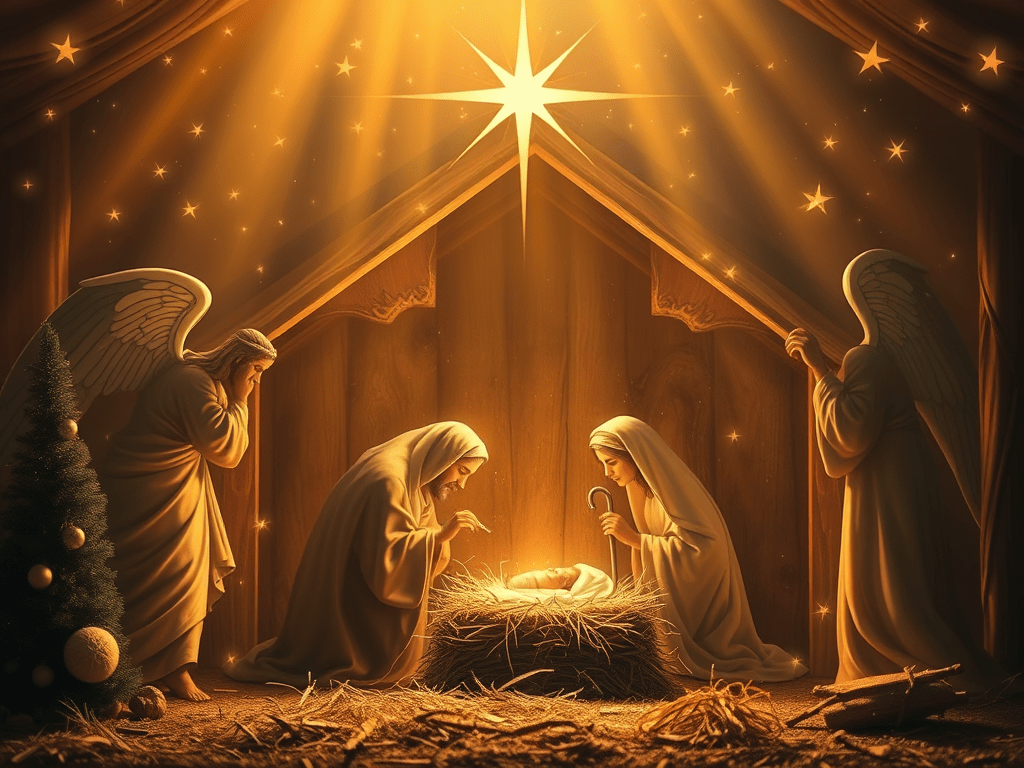
Christmas in our society has become primarily a time of the inescapable marketing of gifts. The culture has turned the religious aspect of Christmas into the story of the birth of a baby that is nothing more than that, and it is difficult to think of Christmas having any more profound significance beyond the remembrance of Jesus’ birth. Even for Christians there comes to be an emphasis on the nativity account with little thought of a deeper story. The details of the birth of Jesus recorded in Scripture are obviously vitally important, but they are but one aspect of this compelling story. One can well imagine many similar births (albeit not births to a virgin) occurring among poor Jews of the period of Jesus’ birth. But Christmas must be first and foremost a remembrance of the Incarnation, when Jesus Christ came into the world to save sinners. That is the element in the Christmas celebration that has lasting meaning.
Creation was a miracle, or rather perhaps a series of miraculous events, which is simply beyond human comprehension. It was an expression of the infinite power, ability, knowledge, creativity, and wisdom of the Eternal God, a tremendous display to the innumerable hosts of heaven. However, it was just that and only that, an extension of God in His nature as God, completely consistent with His obvious attributes. But there is a greater miracle: the Incarnation of the Son of God. It is that greater miracle that is the purpose to creation.
The New Testament book of Hebrews in chapter 2:6-8 references Psalm 8:4-6. In this psalm, David is in awe of God for creating and caring for creation, particularly people. The author of Hebrews points this passage to Jesus, who, by becoming a man, lowered Himself so that He could die for our sins. Hebrews 2:6-10 tells us
But someone has testified somewhere, saying,
“What is man, that You think of him?
Or a son of man, that You are concerned about him?
You have made him for a little while lower than angels;
You have crowned him with glory and honor;
You have put everything in subjection under his feet.”For in subjecting all things to him, He left nothing that is not subject to him. But now we do not yet see all things subjected to him.
But we do see Him who was made for a little while lower than the angels, namely, Jesus, because of His suffering death crowned with glory and honor, so that by the grace of God He might taste death for everyone.
For it was fitting for Him, for whom are all things, and through whom are all things, in bringing many sons to glory, to perfect the originator of their salvation through sufferings.
For in subjecting all things to him, He left nothing that is not subject to him. But now we do not yet see all things subjected to him.
But we do see Him who was made for a little while lower than the angels, namely, Jesus, because of His suffering death crowned with glory and honor, so that by the grace of God He might taste death for everyone.
For it was fitting for Him, for whom are all things, and through whom are all things, in bringing many sons to glory, to perfect the originator of their salvation through sufferings.
The Creator entered humanity and became as those created so that Jesus could be their salvation through His sufferings and provide the way to redemption.
C.S. Lewis argued in Miracles that the Incarnation is at the center of God’s redemptive plan for the world:
“The central miracle asserted by Christians is the Incarnation. They say that God became a Man. Every other miracle prepares for this, or exhibits this, or results from this.”
The Apostle John wrote in John 1:14-16,
And the Word became flesh, and dwelt among us; and we saw His glory, glory as of the only Son from the Father, full of grace and truth. John testified about Him and called out, saying, “This was He of whom I said, ‘He who is coming after me has proved to be my superior, because He existed before me.’” For of His fullness we have all received, and grace upon grace.
From the day of His conception, Christ set aside His previous glory as God to come to the world to atone for our sin. This does not suggest in any way that He stopped being God, became man, and then changed back to being God again. When we read that “the Word became flesh and dwelt among us,” we must remember the paradox that He transferred Himself into His humanity without giving up His deity. He is fully God and fully man, and the Scriptures hold Christ’s two natures in perfect tension. He was not merely who he might have appeared to be. He was human, and He was God. The Apostle Paul explained this in Philippians 2:5-11:
Have this attitude in yourselves which was also in Christ Jesus, who, as He already existed in the form of God, did not consider equality with God something to be grasped, but emptied Himself by taking the form of a bond-servant and being born in the likeness of men. And being found in appearance as a man, He humbled Himself by becoming obedient to the point of death: death on a cross. For this reason also God highly exalted Him, and bestowed on Him the name which is above every name, so that at the name of Jesus every knee will bow, of those who are in heaven and on earth and under the earth, and that every tongue will confess that Jesus Christ is Lord, to the glory of God the Father.
Eternally, totally God, Jesus was born into the world of men and died on our behalf to atone for our unpardonable offense of rebellion against God. There was never a time when He was not God, yet although Jesus is fully God, He “did not count equality with God a thing to be grasped.” He further humbled Himself by “becoming obedient to the point of death, even death on a cross.” The cross was the necessary solution to God’s indignation at human sin and was the supreme demonstration of God’s love for sinners through the gift of His Son. God alone determines how rebellious sinful people can be declared righteous in His holy presence, and He determined that it would be because of Christ’s death on the cross.
This death was the intention of God from before creation. Ephesians 1:4-10 declares that
just as He chose us in Him before the foundation of the world, that we would be holy and blameless before Him. In love He predestined us to adoption as sons and daughters through Jesus Christ to Himself, according to the good pleasure of His will, to the praise of the glory of His grace, with which He favored us in the Beloved. In Him we have redemption through His blood, the forgiveness of our wrongdoings, according to the riches of His grace which He lavished on us. In all wisdom and insight He made known to us the mystery of His will, according to His good pleasure which He set forth in Him, regarding His plan of the fullness of the times, to bring all things together in Christ, things in the heavens and things on the earth.
Further, in Ephesians 3:8-12,
To me, the very least of all saints, this grace was given, to preach to the Gentiles the unfathomable riches of Christ, and to enlighten all people as to what the plan of the mystery is which for ages has been hidden in God, who created all things; so that the multifaceted wisdom of God might now be made known through the church to the rulers and the authorities in the heavenly places. This was in accordance with the eternal purpose which He carried out in Christ Jesus our Lord, in whom we have boldness and confident access through faith in Him.
Before creation, this was the fundamental purpose of God in creating humanity. The incarnation of God in Christ and the death of Christ bringing this eternal worship of the Lamb was the plan of God.
Christianity is completely focused on this atonement which distinguishes Christianity from all other religions. Christ became incarnate to offer up His life as a sacrifice. In 1 John 3:5 he is “manifested to take away our sins.” He is our ransom in 1 Peter 1:18 and 1 Timothy 2:6, offers the appeasement of God’s wrath in Romans 3:25 and 1 John 2:2, and reconciles us to God in Romans 5:10 and 2 Corinthians 5:18-19. He is our substitute throughout the Bible, for example in Isaiah 53 and 1Peter 2:24, “and He Himself brought our sins in His body up on the cross, so that we might die to sin and live for righteousness; by His wounds you were healed.”
One life given instead of another. God Incarnate died for our sins. This presupposes the miracle of the incarnation which was entirely in anticipation of the work of the atonement.
If we as followers of Christ are to observe Christmas, the emphasis should be this supernatural work of God in the incarnation. This is the greatest wonder, the most unfathomable miracle, that God ever did in the world. We ultimately cannot fully understand the Triune God, and we cannot fathom how God could become man in Christ. It is a great mystery, even as we acknowledge that God is all-powerful and can do all things. While we may not comprehend the “how,” we can understand the “why.” God Incarnate came to demonstrate grace, mercy, and love in the most magnificent manner possible, for His eternal glory. In our wondering, we simply acknowledge that there is no real peace, comfort, or future confidence to be found in anything or anyone else, only in the God Who exists, Who is sovereignly in charge, and Who demonstrated His love toward us in the most powerful way possible. Thus, the message of Christmas and Christ’s coming is the message of hope, forgiveness of sin, salvation, and eternal life for believers.
Songs of the Nativity like “Oh, Little Town of Bethlehem” and “Away in a Manger” are fine carols to sing at Christmas. But it is certainly more transformative and meaningful for Christians to sing of the incarnation. A hymn from the 1930’s occasionally heard at Christmas, “Thou Who Wast Rich Beyond All Splendor,” is such a hymn. The second verse reads
Thou who art God beyond all praising,
All for love’s sake becamest man;
Stooping so low, but sinners raising,
Heavenward by Thine eternal plan.
Thou who art God beyond all praising,
All for love’s sake becamest man.

 Michael Stertz